
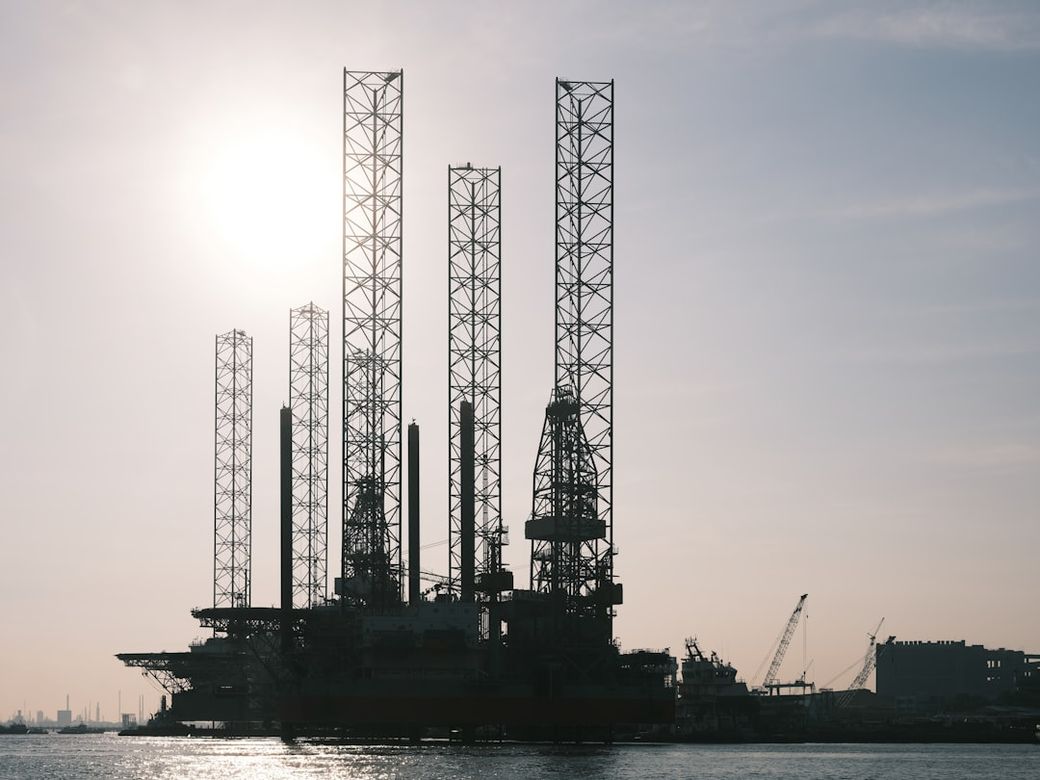
Financing and portfolio restructuring dominated the oil and gas news flow, with balance sheet moves taking precedence over operational headlines. Gulf Marine Services locked in long-term debt terms for a vessel acquisition, BP delivered a sharp quarterly profit rebound despite softer operations, Sound Energy closed a transformative disposal that clears its debt, and Genel Energy revealed the scale of damage from a months-long Kurdistan production halt.
GMS locks in long-term debt for vessel acquisition
Gulf Marine Services (LSE:GMS), which supplies self-propelled, self-elevating support vessels to the offshore energy industry, has converted the bridge loan it drew in January 2026 into a five-year term loan. The facility, equivalent to $37.4 million, originally funded a vessel acquisition on a short-term basis; the restructuring now matches the debt's maturity to the asset's useful life. Shares in GMS traded at 18.7p, down 0.64% on the day.
The conversion sits inside GMS's existing syndicated lending arrangement with HSBC, First Abu Dhabi Bank and Commercial Bank of Dubai, all of which retain the same margin, covenant package and security terms struck previously. No new lenders entered the facility and pricing is unchanged, meaning the deal reshapes the maturity profile without altering the cost of capital. Alongside the conversion, GMS secured a separate AED-equivalent $7.5 million working capital facility from Commercial Bank of Dubai to support expansion into new geographies, with up to 40% of that facility drawable in cash at 2.25% over EIBOR.
"The successful conversion of this facility onto a long-term basis reflects the continued support of our banking syndicate and provides the Company with cost-effective financing appropriate to the useful life of the Vessel," said Alex Aclimandos, chief financial officer of Gulf Marine Services.
The company is explicit that total indebtedness has not increased, this is a maturity-matching exercise, not fresh leverage. That distinction matters for a vessel operator whose assets generate revenue over decades: financing structured around a bridge loan created refinancing risk that has now been removed. Management's own guidance that most of the new working capital facility will back bonds and guarantees rather than cash drawdowns suggests the company is prioritising balance sheet discipline over aggressive expansion, a signal likely to reassure lenders and shareholders watching GMS's gearing as it grows into new markets.
BP profit jumps despite weaker operational reliability
BP (LSE:BP.) reported underlying replacement cost profit of $5.7 billion for the second quarter, up sharply from $3.2 billion in the first, driven by stronger liquids and gas realisations and improved refining margins. Operating cash flow reached $10.9 billion, around $8 billion higher than the prior quarter, after a $1.0 billion working capital build. Shares stood at 562.1p.
The profit surge came despite a deterioration in underlying operations. Upstream plant reliability slipped to 92.4% from 95.7%, reported production fell to 2.2 million barrels of oil equivalent per day from 2.3 million, and refining throughput dropped to 1.47 million barrels per day from 1.53 million. Net debt fell to $22.3 billion from $25.3 billion at the end of the first quarter, helped by the redemption of a $2.9 billion perpetual hybrid bond and a $1.1 billion payment toward Gulf of America settlement liabilities. Chief executive Meg O'Neill's portfolio reshaping continued in parallel, with agreements to sell BP's Austrian retail business, bring partners into Kirkuk, and complete the sale of the Gelsenkirchen refinery stake.
The disconnect between weaker operational metrics and a stronger financial result underscores how much of BP's quarter was carried by pricing and margin rather than volume growth. With net debt falling and non-core disposals accumulating under O'Neill, the company is visibly reshaping its portfolio and balance sheet simultaneously, a strategy that trades near-term production softness for a leaner, more focused asset base.
Sound Energy clears debt with Meridja sale completion
Sound Energy (AIM:SOU) has completed the sale of its Sound Energy Meridja subsidiary to Managem, closing a transaction first announced on 26 May. The transition energy company received cash proceeds of $57 million before working capital adjustments, with shares up 6.25% to 1.7p on the news.
The proceeds will repay all outstanding debt, including Eurobond liabilities on terms set out on 12 June, leaving Sound Energy with an expected cash balance of around $11 million. In a related move, subsidiary Arran Energy Holdings has relinquished its 27.5% interest in the Anoual Exploration Permit and waived its rights in the Grand Tendrara Exploration Permit, tidying up the exploration portfolio alongside the disposal. The company will continue developing its Moroccan businesses, Tayra, its solar power platform, and HyMaroc, its hydrogen and helium exploration venture.
Clearing the balance sheet of Eurobond debt fundamentally resets Sound Energy's position, giving it what management calls flexibility to pursue cash-generative acquisitions across renewable and hydrocarbon transition assets. "We have capital to invest, a clear investment strategy and are already evaluating opportunities that can build a larger, diversified and cash-generative energy business," said the chief executive of HyMaroc. For a company that has spent years managing legacy debt, a debt-free balance sheet with $11 million in cash marks a genuine strategic reset rather than a routine disposal.
Genel reveals cost of Kurdistan output suspension
Genel Energy (AIM:GENL) reported gross average production of 26,400 barrels of oil per day in the first half, down from 78,400 bopd a year earlier, after output was suspended as a precaution when hostilities between the United States, Israel and Iran broke out at the end of February. Shares rose 1.8% to 51.0p despite the sharp production decline.
The Kurdistan-focused producer, which also holds pre-production assets in Oman and Somaliland, said its Tawke licence had been running at 79,900 bopd gross just before the shutdown, close to December's 80,700 bopd rate. The disruption pushed the production business netback to a negative $24 million, against a positive $6 million a year earlier, and drove a free cash outflow of $25 million versus a $5 million inflow in the same period of 2025. Net cash fell to $108 million at 30 June from $134 million at the end of December, with cash of $199 million set against $92 million of bond debt.
Genel has since moved to shore up liquidity, issuing $35 million of new bond debt at 104% of nominal value, implying a yield of 9.7%. The scale of the swing, from a healthy netback to a $24 million loss in a single half, illustrates how exposed the company remains to geopolitical disruption in Kurdistan, even with production capacity intact and ready to resume once conditions allow.