
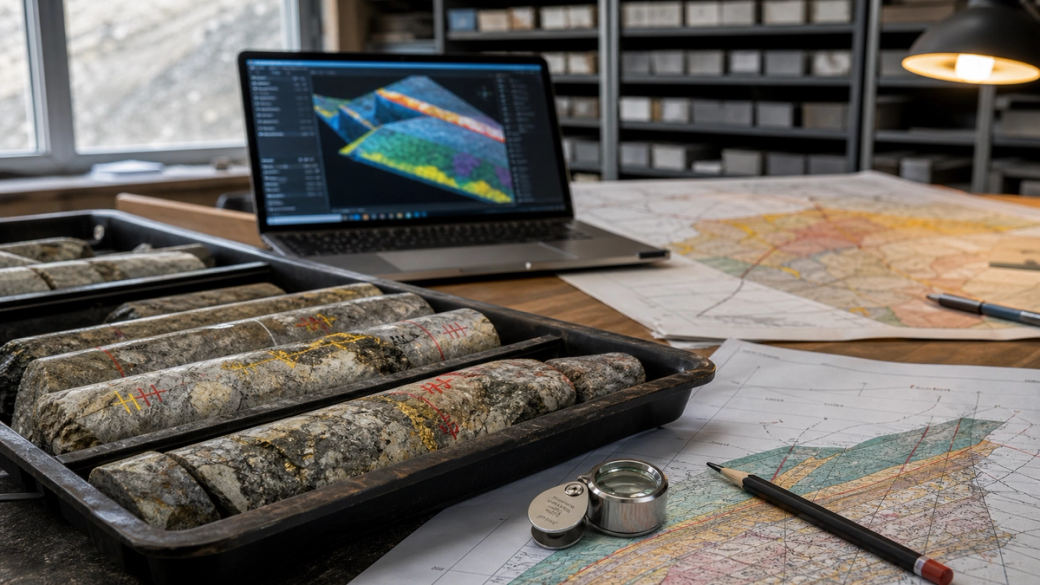
Uru Metals (LSE:URU) said 3D modelling of its Zeb Nickel Project in Limpopo, South Africa, has defined multiple coherent platinum group metal (PGM) mineralisation envelopes within the project's Zone 2 nickel-copper-PGE system.
The AIM-listed exploration company, working with Atticus Geoscience, used historical and recent drill hole data to complete the first stage of the modelling programme.
The work identified a well-developed higher-grade domain in the southeast of the project, where drilling density is greatest and intersections have returned grades of up to approximately 6 g/t combined platinum, palladium, rhodium and gold.
Additional higher-grade zones extend along strike to the northwest, while an apparent gap in mineralisation through the central area may reflect historical boreholes that stopped short of the Critical Zone rather than a genuine break.
The mineralisation style mirrors the broader Northern Limb system that hosts Ivanhoe Mines' Platreef deposit and Valterra Platinum's Mogalakwena complex, both located nearby.
The higher-grade envelopes also sit close to an interpreted chonolith and conduit system between the Uitloop I and Uitloop II ultramafic bodies, offering a further exploration vector.
"We now have a much clearer strategy: build out the higher-grade Zone 2 mineralisation towards a maiden resource, test whether those mineralised areas connect through the central gap, and drill Target 1 for the more concentrated sulphide target", said Richard Montjoie, Uru's exploration manager.
Initial drilling will target the southeastern domain to build toward a maiden mineral resource estimate for Zone 2, with step-out drilling to follow testing the central area.
News Intelligence what this means for the company

3D geological modelling has mapped a coherent higher-grade PGE mineralisation domain at Zeb's Zone 2, with drilling intersections reaching ~6 g/t combined PGM grades in the southeast, and additional zones extending northwest. This advances the company toward its stated goal of building a three-dimensional envelope of higher-grade Zone 2 mineralisation to support a future maiden resource estimate, and clarifies the drilling sequence: initial work will target the southeast domain, followed by step-out drilling to test whether mineralisation connects across a central gap.
The modelling resolves structural ambiguity (whether the central gap is geological or an artefact of historical drilling) and prioritises the highest-grade area for resource definition, reducing execution risk on the path to a maiden resource. However, this remains an exploration-stage outcome; no resource has been estimated, and the company must still deliver drilling results that confirm grade and tonnage at scale.
Insights assembled by AI. Editor-reviewed and grounded in tickstock’s coverage and proprietary knowledge graph.
Content is for informational purposes only, not financial advice.