
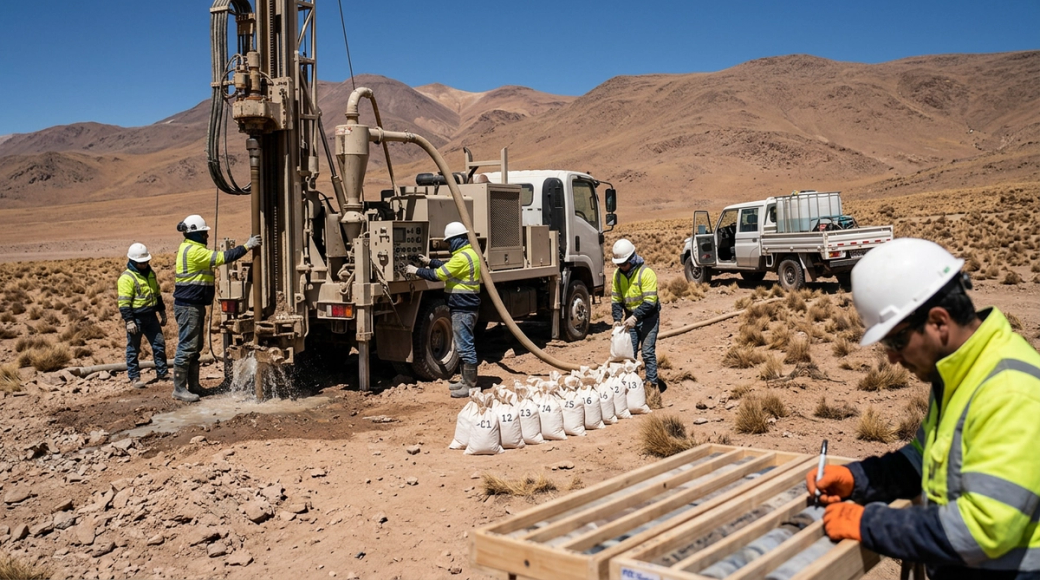
Galantas Gold Corporation (AIM:GAL) is expanding the drill programme at its Indiana gold-copper project near Copiapó, Chile, to 12,500 metres from a previously planned 5,000 metres.
The Toronto and AIM-listed explorer has drilled 5,060 metres so far and will fund the extra metreage from its current cash position.
The programme targets extensions of the Bondadosa and Flor de Espino veins, new mineralised structures not exposed at surface, and high-grade zones at structural intersections.
Twelve exploration holes totalling 4,852 metres, plus one 208-metre infill hole at Flor de Espino, have been completed, though most assay results remain outstanding after laboratory delays caused by flooding and power outages in Chile's Coquimbo region.
Twelve of 13 holes intersected the targeted veins, and 12 new visually mineralised structures carrying pyrite and chalcopyrite have been identified across 10 holes.
For the first time at Indiana, disseminated sulphide mineralisation including molybdenite has been observed in drill core, alongside hypogene chalcocite and bornite linked to intense alteration resembling skarn mineralisation.
Chief executive Mario Stifano said the company is "very encouraged" by the observations, noting the disseminated mineralisation's significance is still being assessed alongside new surface targets identified across an approximately 8km by 10km land package within a major iron oxide-copper-gold belt.
Surface mapping has also identified a new target, La Maravilla, along a newly recognised structure roughly 1.1km from the historic Flor de Espino mine workings.
Galantas said assay results will be reported once received from alternative certified laboratories now processing the backlog.
News Intelligence what this means for the company

Galantas is doubling its Indiana drill programme to 12,500 metres after visual evidence of new mineralisation styles—including disseminated sulphides with molybdenite and skarn-like alteration never before seen at the project—and funding the expansion from existing cash without dilution. Twelve of 13 holes hit targeted veins, and 12 new mineralised structures were identified, though assay results remain pending due to Chilean lab delays; the expansion targets vein extensions, subsurface structures, and high-grade intersections across an 8km × 10km package in a major iron oxide-copper-gold belt.
The expansion signals management confidence in Indiana's upside and demonstrates cash flexibility post-fundraising, but the investment case remains contingent on assay results—currently delayed—and the significance of the newly observed disseminated mineralisation, which the company notes is still being assessed.
Insights assembled by AI. Editor-reviewed and grounded in tickstock’s coverage and proprietary knowledge graph.
Content is for informational purposes only, not financial advice.