
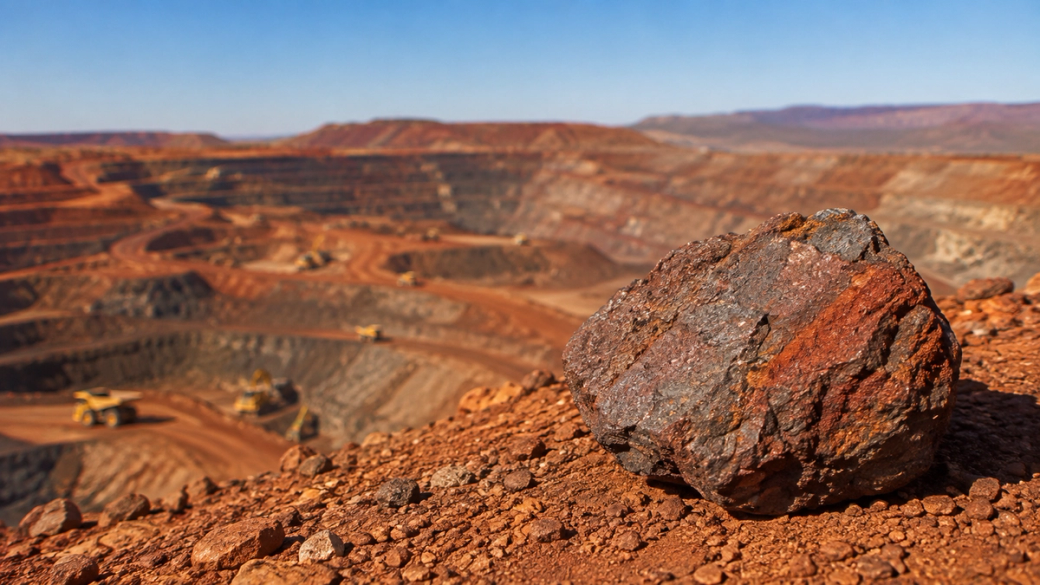
Rio Tinto has told investors that its global iron ore sales rose 3% year-to-date to 255.3 million tonnes for the nine months to 30 September, as the miner maintained its full-year production and sales guidance across iron ore, copper, aluminium and lithium.
Copper-equivalent production rose approximately 1% year-to-date, with Oyu Tolgoi the standout performer: copper production at the Mongolian mine climbed 27% year-on-year in the third quarter and 29% year-to-date, with the operation running at an annualised rate of around 450,000 tonnes in the quarter.
Total consolidated copper production was flat year-on-year in the quarter at 205,000 tonnes, held back by a flash converting furnace rebuild at Kennecott following a breach in late June, which Rio Tinto said it completed around 70 days later, at the end of August, ahead of plan.
Simandou, the Guinea iron ore project in which Rio Tinto's SimFer joint venture holds an 85% stake alongside the Government of Guinea, hit an annualised production run-rate of approximately 10 million tonnes per annum (100% basis) in the quarter as it continues ramping toward a targeted 60 Mtpa run-rate during the second half of 2028.
Lithium carbonate-equivalent production rose 33% year-to-date to 40.3kt, despite what the company called adverse weather affecting third-quarter operations, with ramp-up at Fénix 1B continuing to progress.
Pilbara iron ore sales increased 2% year-on-year in the quarter to 85.7 million tonnes (100% basis), which Rio Tinto attributed to mine performance and sustained port inventories.
Chief executive Simon Trott said the group delivered "strong operational performance in the third quarter" and that major projects "remain on schedule and budget, underwriting our growth profile to 2030."
The company reiterated it remains on track for an annualised productivity benefit run-rate of $1.8 billion by the end of 2026, a target it has referenced in its half-year results.
Rio Tinto also disclosed progress on its capital release programme, announced at its 2025 Capital Markets Day, saying it has entered arrangements to release more than $2 billion year-to-date for redeployment, as part of a targeted $5 billion to $10 billion programme.
Among the steps taken: a July agreement with Yindjibarndi WaterCo for the proposed sale of the Dampier Seawater Desalination Plant in Western Australia, and the sale of land in Kitimat, British Columbia, to LNG Canada for its Phase II project, expected to complete in the fourth quarter.
Trott said the company made "further significant steps in decarbonising our business" in the quarter, citing progress on Pacific Aluminium smelter repowering arrangements following the Tomago and Bell Bay power agreements.
Unit cost guidance was also maintained, with Pilbara iron ore unit cash costs guided at $23.50 to $25.00 per wet metric tonne and copper C1 net unit costs across Kennecott, Oyu Tolgoi and Escondida guided at 30 to 50 US cents per lb.
Rio Tinto said diesel price increases had added $0.9 per tonne to year-to-date Pilbara unit costs versus 2025, with the full-year impact expected to rise to $1.1 per tonne assuming current spot diesel prices of approximately $175 per barrel in the fourth quarter.
